Will submarine rift sap Europes support for US policy on China
The row that has broken out about Australia’s decision to scrap a deal to buy French submarines and switch to U.S.-made vessels â€" a move that Paris calls a “stab in the back†â€" is about more than French amour propre.
It risks opening even deeper fissures in the transatlantic alliance, the bedrock of U.S. foreign policy for more than seven decades.
Why We Wrote ThisEuropeans, slighted by Washington’s recent cavalier treatment, are pondering a more independent foreign policy path. That could mean less international backing for President Biden’s tough line on China.
The way Australia, the United States, and Britain had negotiated in secret for months to create a new security alliance dubbed AUKUS; the way neither European Union nor NATO allies were forewarned of the announcement; all that smacked of the way they had been left out of the loop on last month’s U.S. withdrawal from Kabul, Afghanistan.
That has left some in Europe wondering whether they can rely on Washington anymore, and it has reinforced arguments that the Europeans should take a more independent foreign policy tack on issues such as China, rather than let America take the lead.
As President Joe Biden seeks to rally allies into a democratic front against autocratic leaders such as China’s Xi Jinping, Europe’s overall aim, said EU foreign policy chief Josep Borrell last week, is “cooperation, not confrontation.â€
London
First came the verbal brickbats, accusations of “lying, duplicity … treachery!†Then the dramatic recall of an ambassador from Washington.
Yet it wasn’t the pace, nor even the passion, of last week’s démarche against the United States that was most extraordinary. It was the source.
It didn’t come from a rival such as Russia or China, but from America’s oldest international ally, France. Ties with Europe are already strained; this new diplomatic firestorm risks opening even deeper fissures in the transatlantic alliance â€" the bedrock of U.S. foreign policy for more than seven decades.
Why We Wrote ThisEuropeans, slighted by Washington’s recent cavalier treatment, are pondering a more independent foreign policy path. That could mean less international backing for President Biden’s tough line on China.
France is not the only European Union member of NATO to be asking itself whether the old continent can rely on Washington with the same certainty as before. And the doubters are now wondering whether they should adopt a more independent tack on their own security, and on key foreign policy issues like China, rather than let America take the lead.
Hussein Waaile/Reuters
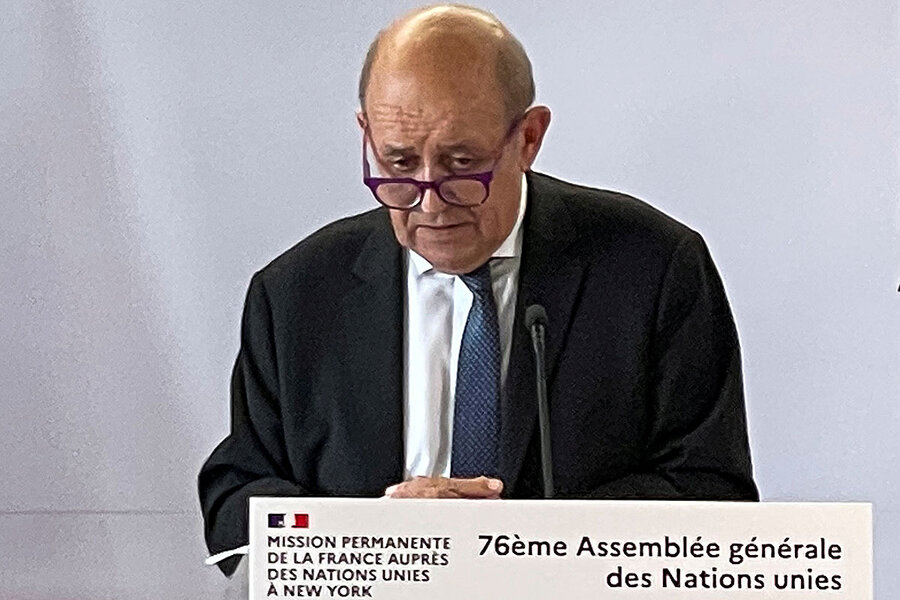
French Foreign Minister Jean-Yves Le Drian speaks during a news conference in New York, on the sidelines of the U.N. General Assembly. He cautioned against the "highly confrontational orientation" that he feared Washington was taking against China, as it founded a new security pact in the Indo-Pacific region.
The spark for the latest tension was the announcement of a new alliance â€" dubbed AUKUS â€" under which the U.S. and Britain will provide nuclear-powered submarines to Australia and jointly develop other high-tech military and intelligence tools for deployment in the Indo-Pacific region.
That meant the summary cancellation of a deal between the Australians and the French, for conventional, diesel-powered submarines. In practical terms, France lost nearly $66 billion in business, and many of the jobs relying on it.
But it wasn’t just those issues that provoked France’s fury â€" and the first withdrawal of its chief envoy to Washington since the French sided with the American Colonies in the Revolutionary War.
Rather, it was the manner in which the rebuff was delivered â€" a “stab in the back,†Foreign Minister Jean-Yves Le Drian called it. AUKUS emerged from months of top-secret negotiations that kept Paris in the dark. France first heard of the deal from Australia, hours before the formal White House announcement last Wednesday, and after the news had leaked in the news media.
The EU wasn’t given notice either. Nor, it appears, was NATO. And that struck an especially raw nerve: EU states and NATO’s European members are still smarting from being left out of the loop on last month’s rapid U.S. withdrawal from Kabul, Afghanistan.
The overall effect has been to gut the initial view in European capitals that President Joe Biden would quickly repair the transatlantic bonds that President Donald Trump had so denigrated. “This brutal, unilateral and unpredictable decision reminds me a lot of what Mr. Trump used to do,†Mr. Le Drian declared.
The hope in the U.S. is that France’s anger will gradually subside. Mr. Biden reached out this week to schedule a phone call with President Emmanuel Macron to try at least to clear the air.
Mick Tsikas/AAP/AP
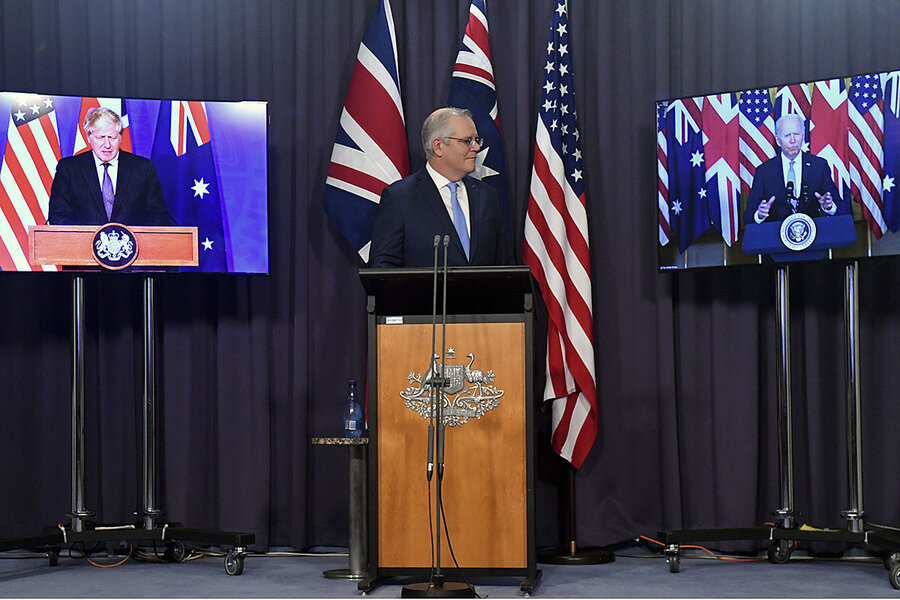
Australian Prime Minister Scott Morrison appears on stage with video links to British Prime Minister Boris Johnson and U.S. President Joe Biden to announce the creation of a new security alliance, widely seen as aimed at curbing Chinese military ambitions at sea.
But the substance behind AUKUS is likely to prove tougher to finesse: a new, Anglo-Saxon security alliance whose European member has chosen to leave the EU, aimed clearly at China. And China is now Washington’s absolute foreign-policy priority, whatever Europeans may think about that.
For Mr. Macron, the logical European response is clear. He has long been pressing EU colleagues to forge greater “strategic autonomy†from the Americans. During the Trump years, he went so far as to pronounce NATO “brain-dead†â€" a remark he recanted during Europe’s early diplomatic honeymoon with the Biden administration.
His argument has been gradually gaining support among some other EU states. It will have been strengthened by the way the U.S. sidelined the Europeans in Afghanistan, and by AUKUS.
But there’s a major caveat: “strategic autonomy†costs money. It means a commitment to far higher defense spending than most European countries have so far been ready to countenance. And it’s worth noting that no other European leaders have rushed to echo Paris’ angry denunciations of Washington over AUKUS.
But that does not necessarily mean that they are ready to follow what Mr. Le Drian calls the “highly confrontational orientation†toward Beijing that Washington has adopted, especially since the EU had been working on its own strategic plan for the Indo-Pacific region, which it unveiled last week.
“We regret not having been informed†about AUKUS, said the EU’s foreign policy and security commissioner, Josep Borrell. “We must survive on our own, as others do,†he added.
France itself is already a key player in the Indo-Pacific, home to some 1.6 million of its citizens in overseas territories defended by 8,000 soldiers and a naval force, including nuclear submarines.
The EU document set out plans for possible naval deployments by member states to “help protect maritime lines of communication and freedom of navigation,†a veiled reference to stymieing Chinese maritime ambitions.
Get the Monitor Stories you care about delivered to your inbox.
But the plan’s tone and emphasis were markedly different from Washington’s increasingly tough stance toward China â€" in part, perhaps, because EU states may be more reluctant to risk their valuable trade and investment ties with Beijing.
As President Biden seeks to rally allies into a democratic front against autocratic leaders such as Xi Jinping, Europe’s overall aim, said Mr. Borrell, was “cooperation, not confrontation.â€
0 Response to "Will submarine rift sap Europes support for US policy on China"
Post a Comment